Hyperpigmentation Around The Eyes
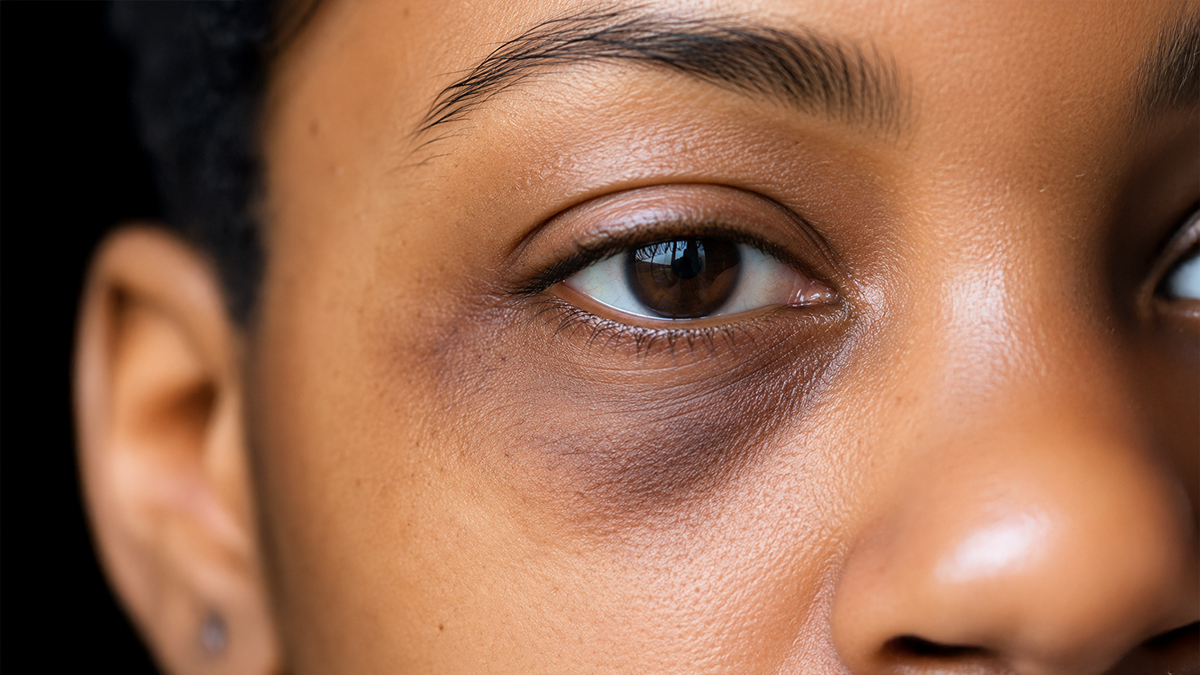
Hyperpigmentation on the face, could it be pigmentary dermacation lines on the face?
Pigmentary demarcation lines (PDLs) are areas of an abrupt transition from hyper‐ to hypo‐pigmented or normal skin colour.
They are seen on limbs, face, and sometimes trunk.
They are more commonly reported in Japanese and black race
They are more common in females than in men.
PDL are due to differences in melanocyte distribution that may be influenced by multiple factors.
Facial PDL present as bilaterally symmetrical, homogenous hyperpigmentation extending from lateral orbit or angle of mouth differentiating from
Facial PDL may appear around puberty and may persist throughout life.
The cause is not known but it’s believed to have a genetic predisposition.
Facial PDL are thought to present from childhood and goes unnoticed, only to become prominent after certain triggering factors like hormonal changes at puberty or pregnancy make them appear more darker
Facial PDLs are classified as Groups F, G, and H.
PDL Group F represents an inverted cone shaped area of hyperpigmentation over the lateral aspect of the face extending from lateral orbital rim inferiorly or inferio-laterally.
PDL Group G occurs at site similar to Group F, but with two inverted cones with a normal patch of skin in between two inverted cones forming letter “W”
PDL Group H occurs on the lower face as a linear hyperpigmented band extending from the angle of mouth to the lateral aspect of the chin.
What can they be mistaken for?
Facial PDL should be considered in the diffe rential diagnosis of any facial pigmentation, especially if it is bilaterally symmetrical. Common conditions that can be mistaken for PDL are:
Melasma, which is usually blotchy and may occur at different sites such as forehead, nose, above the upper lip etc
Post inflammatory hyperpigmentation usually occurs in areas of previous pathology like acne or eczema.
Treatment
Is not always successful.
Affected individuals needs to strictly use sunscreens to avoid further pigmentation of the affected areas.
More blogs
The Importance of Regular Skin Checkups
Why Is My Skin Dull?